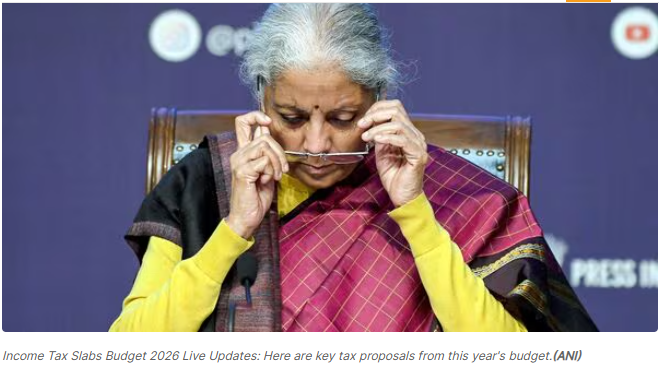

On 1 February 2026, Finance Minister Nirmala Sitharaman presented India’s Union Budget 2026–27 in the Parliament, unveiling a comprehensive fiscal roadmap designed to strengthen economic growth, boost domestic manufacturing, and enhance India’s global competitiveness. This marks her ninth consecutive budget presentation — reflecting continuity and experience in managing India’s economic policy.
🎯 Core Theme & Vision
The 2026 Budget emphasizes three core objectives — accelerating economic growth, building productive capacities, and ensuring inclusive opportunities for all. It prioritizes investment-led development while reinforcing fiscal discipline amid a volatile global economic environment.
📈 Economic Growth & Fiscal Goals
- 📌 Nominal GDP growth is projected around 10 %, signaling robust economic momentum.
- 🚨 Fiscal deficit is targeted at about 4.3 % of GDP, reflecting a balance between investment and fiscal prudence.
- 📊 Central government debt is estimated around 55.6 % of GDP.
These projections underscore the government’s intent to promote growth while maintaining macroeconomic stability.
🏗️ Infrastructure & Manufacturing Push
One of the standout features of the Budget is the significant increase in capital expenditure — ₹12.2 lakh crore for the fiscal year, aimed at driving infrastructure development across sectors. This includes investments in:
- Seven high-speed rail corridors to improve connectivity and regional development.
- Expansion of national waterways and freight corridors.
- Support for rare earth mineral processing and strategic manufacturing sectors.
These initiatives are poised to catalyze long-term economic growth and better linked domestic markets.
🏭 Boosting Strategic & Frontier Sectors
To strengthen India’s domestic manufacturing and technological prowess:
- 💡 India Semiconductor Mission 2.0 was announced to expand semiconductor production, develop supply chains, and attract investment.
- 🧬 Focus on sectors like biopharma, electronics, and critical minerals under strategic manufacturing schemes.
- Initiatives like Biopharma SHAKTI will help India emerge as a global biotech hub.
These initiatives aim to reduce import dependency and stimulate innovation-led growth.
💼 Support for MSMEs & Entrepreneurship
Micro, Small and Medium Enterprises (MSMEs) receive a boost through targeted support mechanisms and credit enhancements, strengthening their role as key drivers of employment and local value creation.
🧾 Taxation & Compliance Reforms
- 📜 The new Income Tax Act, 2025 will come into effect on 1 April 2026 with simplified norms.
- 📆 Deadlines for revised Income Tax Returns (ITRs) have been extended, easing compliance pressures.
- 💰 Tax Collected at Source (TCS) on various foreign outlays, like tours and education, has been rationalized.
While individual tax slabs remained largely unchanged, several compliance-focused reforms aim to streamline the tax regime for taxpayers and businesses alike.
Income Tax Slabs and rates: Old vs new regime changes
FM Sitharaman did not announce any new change in the tax slabs under the old or new income tax regime. The old vs new tax regime have different tax slabs. Check the tax rates in terms of old vs new tax regime —
Check the income tax slabs for the old tax regime:
Income up to ₹2,50,000 – Nil
₹2,50,001 to ₹5,00,000 – 5%
₹5,00,001 to ₹10,00,000 – 20%
Income above ₹10,00,000 – 30%
Under new tax regime:
Income up to ₹4 lakh – Nil
₹4 lakh to ₹8 lakh – 5%
₹8 lakh to ₹12 lakh – 10%
₹12 lakh to ₹16 lakh – 15%
₹16 lakh to ₹20 lakh – 20%
₹20 lakh to ₹24 lakh – 25%
Income above ₹24 lakh – 30%
🌐 Integration with Global Markets
The Budget also signals a push toward greater foreign investment facilitation, regulatory clarity, and global economic integration. Enhanced foreign ownership norms and strategic engagement with global partners reflect India’s aspiration to attract long-term international capital.
📌 Bottom Line
The Budget 2026–27 emphasizes sustained growth, structural reforms, and strategic investment, laying a foundation for a resilient economy. While some taxpayers awaited direct relief in income tax slabs, the broader focus remains on investment-driven development, infrastructure expansion, and job creation — underscoring India’s commitment to long-term economic stability and prosperity.