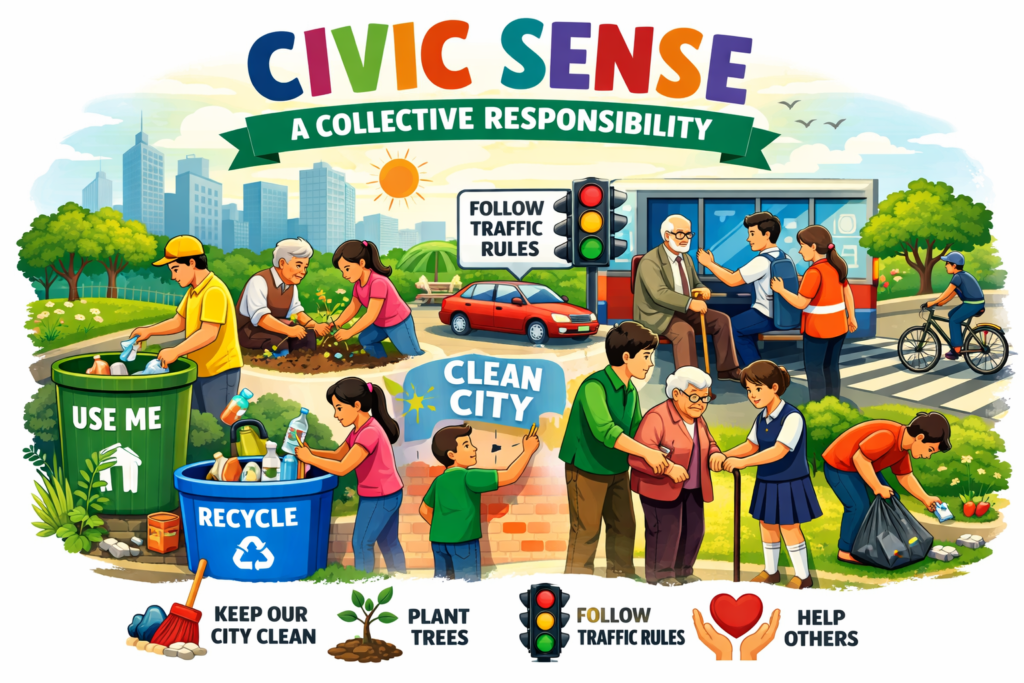

Civic sense in society is not just about following rules—it is about respecting shared spaces, caring for the environment, and being responsible citizens.
What Civic Sense Means in the Context
Civic sense includes everyday behaviors that affect public life. From how we use roads and public transport to how we treat parks, markets, and government facilities, our actions shape the quality of life around us.
It reflects in simple habits like:
- Not littering in public places
- Following traffic signals
- Standing in queues
- Respecting public property
- Keeping surroundings clean
When people practice these habits regularly, cities become cleaner, safer, and more organized.
Current Challenges in Society
Despite awareness, lack of civic sense is visible in many places. Common issues include:
- Throwing garbage on streets even when dustbins are nearby
- Spitting on walls and public areas
- Ignoring traffic rules and signals
- Encroaching on public spaces
- Damaging buses, trains, and government property
These actions may seem small individually, but together they create major problems like pollution, traffic chaos, and poor sanitation.
Why Civic Sense is Important
In such a large society, discipline and public responsibility become even more important.
Better civic sense can lead to:
- Cleaner cities and villages
- Reduced pollution
- Fewer road accidents
- Better public health
- Stronger national image
When citizens take responsibility, development becomes faster and more effective.
Role of Education and Family
Civic sense begins at home. Children learn by observing parents and elders. If they see responsible behavior like using dustbins, respecting others, and following rules, they grow up with the same mindset.
Schools also play a key role by teaching values like discipline, cleanliness, and respect for society.
Government and Public Efforts
Government initiatives like cleanliness drives and awareness campaigns encourage people to adopt better habits. But real change can only happen when citizens cooperate and take ownership.
Rules alone cannot build a clean and disciplined nation—people’s mindset must change.
The Way Forward
Improving civic sense in Indian society does not require big actions. Small daily habits can bring big change:
- Keep your surroundings clean
- Follow traffic rules
- Respect public spaces
- Be patient and stand in queues
- Encourage others to do the same
If every individual takes one step toward responsible behavior, the whole society moves forward.
Conclusion
Civic sense is a reflection of how much we care about our country and the people around us. A developed nation is not defined only by infrastructure but also by the discipline and responsibility of its citizens.
For India to grow stronger and cleaner, civic sense must become a natural part of everyday life. Change begins with each one of us.